

Team 03 - 2026
Beyond Borders. Different Perspectives. One Shared Vision.
Bringing together diverse experiences, skills and ideas from across the world to
collaborate, innovate and achieve a common goal.

Product Owner
Rohit Thakur
Muscat, Oman
Rohit Thakur transforms complex business into user-friendly products. With over 10 years in digital banking, he has implemented mobile banking features at Saudi National and improved efficiency by reducing rework by 20%. Lead Business Analyst, he is currently focused onure-to-Pay transformation and AI adoption. A certified Product Owner, he shares insights public speaking and his book, "The Evolving Analyst," while mentoring future analysts and integrating business, technology, and design for lasting impact.

Project Manager
Agneshwari Adhiya
New York, USA
Agneshwari Adhiya is an education professional with over 15 years of experience in academic administration and operations, including roles as and Acting Registrar. She specializes in process management, student records, stakeholder coordination, and compliance An IIBA Certified ECBA professional, she is enhancing her leadership skills through business analysis and methodologies like Agile and Waterfall, aiming align business needs with technology solutions for impactful organizational value.

User Interface & User Experience
Deborah Edu
London, UK
I’m a Business Process Analyst with experience in digital transformation across financial services. I specialise in requirements elicitation, process design and stakeholder engagement. On the SDLC Experience Program, I worked as UI/UX designer and contributed to prompt engineering for the development build. I’m passionate about building user centred products that solve real problems and am working towards product ownership.

Business Analyst
Kehinde Adebayo
Nigeria
Kehinde Adebayo is a Business Analyst with background in digital banking operations, customer service, and passion for solving business problems through process improvement, data analysis, and technology.
She has experience working closely with business owners, understanding operational challenges, and collaborating with different teams. These experiences have shaped her approach to identifying problems and translating business needs into practical solutions.

Business Analyst
Hwee Ling Lee (Jessie)
Kuala Lumpur, Malaysia
Jessie Lee bridges business needs and technology, turning ideas into practical solutions that deliver results. With 10+ years in business systems, application support, and campaign operations, Jessie works closely with business users, technology teams, and vendors across multiple countries. As Business Analyst for My Hub (Team 3) in the SDLC Experience Program 2026, Jessie assessed the current state, defined scope, prioritised requirements, and mapped process flows. Jessie is also exploring how AI can make everyday work simpler and help teams make better decisions.

Business Analyst
Eniola Alawiye
Blackpool, North West, United Kingdom
Eniola Alawiye is a Senior Business Analyst at the Department for Work and Pensions (DWP), with experience in business analysis, digital transformation and stakeholder engagement. She is passionate about bridging business needs with technology solutions, driving strategic improvements and delivering business value. She is actively developing her expertise in Business Architecture, with aspirations to become a strategic architecture leader.

Quality Assurance Analyst
Monday Daramola
Northampton, United Kingdom
I’m Monday Daramola. Ten years in education taught me to put people first, and I’m now bringing that into Business Process Analysis and Quality Assurance. As a QA Analyst on the SDLC Experience Program, I stepped into users’ shoes, hunting bugs, broken states and edge cases, and checking every interaction worked across devices and browsers.

Developer
Amarachi Ezidiegwu
Abuja, Federal Capital Territory, Nigeria
Amarachi Ezidiegwu is a Business Analyst and Strategic Systems Advisor with over three years of experience.
As the Founder of Ximena Consulting, she helps businesses align their strategies and systems for sustainable growth, focusing on business architecture, systems thinking, and digital transformation.
MY Hub
University Advising Portal
Product Vision & Objectives
Project Manager: Agneshwari.Adhiya
Value to Team
Product vision always provide the right direction for the team.
We avoided scope screep whenever we got deviated and had lengthy discussion.
Lesson Learned
The problem statement at begining looked very easy but as and when we moved our discussion further the problem got deeper.
Even the tiny doubt created a good impact in brainstorming sessions.
Product Vision Statement
For university students and academic advisors who need a simple, reliable, and accessible way to manage academic advising activities, the University Advising Portal is a centralized, mobile-friendly advising solution that enables easy appointment scheduling, centralized advising records, and clear visibility into degree progress. Unlike the current fragmented, confusing, and manual advising process, our product provides a simple, efficient, consistent, and transparent advising experience.

Project Deliverables - By the Project Manager
Advising Portal Project Plan
Project Manager: Agneshwari.Adhiya
Value to Team
Established team 's project management foundation by translating the business case into a structured, PMBOK-aligned Project Plan before Product Owner elicitation. Defined the initial project roadmap, objectives, scope, deliverables, responsibilities, risks, and dependencies, providing a shared baseline for cross-functional planning and coordination.
Lesson Learned
An initial project plan provides essential direction, but assumptions should be validated early with the Product Owner and technical team.
1. Project Overview
1.1 Purpose
This Project Plan defines how the University Advising Portal MVP will be planned, coordinated, monitored, and delivered during the SDLC Experience Workshop. It establishes the project's scope, objectives, schedule, resources, quality approach, risks, communications, stakeholders, assumptions, constraints, dependencies, and open questions.
1.2 Project Summary
For university students and academic advisors who need a simple, reliable, and accessible way to manage academic advising activities, the University Advising Portal is a centralized, mobile-friendly advising solution that enables easy appointment scheduling, advising records, and clear visibility into degree progress.
The university needs to improve its current advising process, which is confusing, slow, and inconsistent. Students currently navigate multiple systems to schedule appointments and understand their academic progress, while advisors experience recurring double-bookings and spend significant time locating advising notes. Advisors also rely on personal tools because the existing portal is unreliable.
2. Product Objectives & Success Measures
Product Objective AND TARGET
Eliminate double-booking TARGET 0 double-bookings within 60 days
Improve advisor note retrieval TARGET Under 10 seconds within 60 days
Reduce appointment scheduling time TARGET Under 2 minutes within 90 days
Improve student experience TARGET 80% of students report scheduling as easy/very easy within 90 days
Increase advisor adoption TARGET 95% advisor adoption within 90 days
Drive student adoption TARGET 95% student adoption within 90 days
3. Scope Management
3.1 In Scope –
1. University Advising Portal MVP
-
Students can view available advising appointment times.
-
Students can book an advising appointment.
-
Students receive appointment confirmation.
-
Advisors can view upcoming appointments.
-
Advisors receive appointment notification.
-
Students and Advisors should receive reminder 30 minutes before the appointment.
-
The system prevents double-booking.
2. Centralized Advisor Notes
-
Advisors can access a student academic profile.
-
Advisors can create and save advising notes.
-
Advising notes are stored in a centralized location.
-
Advisors can quickly retrieve previously recorded notes.
-
Students can quickly retrieve recorded notes.
3. Degree Progress View
-
Students can view their completed credits.
-
Students can view their remaining credits.
-
Degree progress is presented in a simple and understandable format.
4. Accessibility and Usability
-
The portal will be easily accessible.
-
The portal will work on mobile devices.
-
The experience will be simple enough for new students to use without training.
5. Privacy and Data Protection
-
Protect student academic and advising information from unauthorized access.
-
Ensure access to academic and advising records is based on appropriate user roles and permissions.
-
Include appropriate privacy and data-protection requirements in the MVP design and testing.
-
Ensure the portal handles student information in accordance with applicable university privacy policies and regulations
3.2 Out of Scope
1. Course registration or enrollment
2. Course add/drop functionality
(document continues....)
Project Schedule
Project Manager: Agneshwari.Adhiya
Value to Team
The project schedule served as an essential project management tool for organizing work, prioritizing tasks, coordinating cross-functional activities, and monitoring progress against planned deadlines. The schedule also provided a practical framework for adjusting priorities and keeping the team aligned with project milestones.
Lesson Learned
A project schedule should be treated as a living management tool rather than a fixed timeline. We learned the importance of estimating task durations realistically, identifying dependencies early, and regularly reviewing progress with team members.

Kanban Board
Business Analyst: Eniola Alawiye

(the document continues....)
Project Scope
Project Manager: Agneshwari.Adhiya
Value to Team
Developed the initial Project Scope by translating the business case into clearly defined project boundaries, key features, expected deliverables. The scope helped the team distinguish core requirements, preventing uncontrolled scope expansion, and keeping the team focused on achievable deliverables within the workshop timeline.
Lesson Learned
Confirm data sources, integrations, and feasibility before finalizing scope; document changes and deferred features as decisions are made.
2.1 In Scope
The project will deliver the following capabilities as part of the University Advising Portal MVP:
In Scope
-
View available advising times
-
Book advising appointments
-
Cancel advising appointments at least 6 hours before the scheduled appointment
-
Update advisor availability when an appointment is cancelled
-
Receive booking confirmations
-
Select appointment mode: In-Person or Online
-
Prevent double-booking
-
Create and retrieve advisor notes
-
View completed and remaining credits
-
Access current student academic and degree-progress information through an existing approved university data service
-
Access current advisor availability through an existing approved university data service
-
Mobile and accessible user experience
2.2 Out of Scope
-
Course registration or enrollment
-
Course add/drop functionality
(the document continues....)
Scope Statement
Business Analyst: Hwee Ling Lee (Jessie), Eniola Alawiye, Kehinde Adebayo
Value to Team
Defined the agreed project deliverables and exclusions to support a common understanding of what the prototype would demonstrate.
Lesson Learned
Review and formally reconfirm the scope statement after major decisions, and ensure that the final deliverables remain aligned with agreed project objectives.
1. Project Overview
The university needs to improve its current advising process, which is confusing, slow and inconsistent for students and advisors. Students currently navigate multiple systems to schedule appointments and understand their academic progress, while advisors experience recurring double-bookings and spend significant time locating advising notes. Advisors also rely on personal tools because the existing portal is unreliable.
The business needs a following
-
Conflict-free appointment scheduling
-
Easy retrieve advising notes which is store centrally
-
A screen showing clear degree progress students
-
Mobile friendly solution
2. Project Objectives
-
Eliminate double-booking
-
Improve advisor note retrieval
-
Reduce appointment scheduling time
-
Improve student experience
-
Increase advisor adoption
-
Drive student adoption
3. In-Scope Boundaries
The project will deliver the following capabilities as part of the University Advising Portal MVP:
1. Conflict-Free Appointment Scheduling
-
Students can view available advising appointment times.
-
Students can book an advising appointment.
-
Students receive appointment confirmation.
-
Advisors can view upcoming appointments.
-
Advisors receive appointment notification.
-
Advisors can cancel the appointments.
-
Students can cancel the appointments.
-
Students and Advisors should receive reminder 30 minutes before the appointment.
-
The system prevents double-booking.
2. Centralized Advisor Notes
-
Advisors can access a student academic profile.
-
Advisors can create and save advising notes.
-
Advising notes are stored in a centralized location.
-
Advisors can quickly retrieve previously recorded notes.
-
Students can quickly retrieve recorded notes.
3. Degree Progress View
-
Students can view their completed credits.
-
Students can view their remaining credits.
-
Degree progress is presented in a simple and understandable format.
4. Accessibility and Usability
-
The portal will be easy accessible.
-
The portal will work on mobile devices.
-
The experience will be simple enough for new students to use without training.
5. Privacy and Data Protection
-
Protect student academic and advising information from unauthorized access.
-
Ensure access to academic and advising records is based on appropriate user roles and permissions.
-
Include appropriate privacy and data-protection requirements in the MVP design and testing.
-
Ensure the portal handles student information in accordance with applicable university privacy policies and regulations
4. Out-of-Scope Boundaries
-
Course registration or enrolment
(document continues....)
My HUB - MVP
Business Analyst: Hwee Ling Lee (Jessie)

Value to Team
Gave the team one end-to-end view with requirement IDs on each step, which supported traceability and testing.
Lesson Learned
Split the flow into smaller journeys and use a tool to link requirements, so changes cause less rework.
My HUB - Context Diagram
Business Analyst: Hwee Ling Lee (Jessie)
Value to Team
Provided a single-page view of the system's users (students and advisors) and its connections, giving the team a shared understanding of scope.
Ensured that requirements and process flows aligned to the same system boundary.
Lesson Learned
Tools and external connections should be confirmed before drafting the diagram. A late change required the diagram to be redrawn, and the requirements and process flows to be rechecked.
bb
Use Case Diagram

REQUIREMENTS LIST and
BUSINESS REQUIREMENTS LIST
Business Analyst: Hwee Ling Lee (Jessie)
Value to Team
Created a clear baseline of what the solution must deliver and why, keeping Business, and team aligned.
Lesson Learned
Requirements should be clear, traceable, and agreed early. Changes should be updated consistently across requirements, user stories, process flows, and testing to avoid gaps and rework.


(document continues....)
BUSINESS REQUIREMENTS

(document continues....)
Business Analyst: Eniola Alawiye
University Advising Portal R2 Current (Swimlane Diagram)
Value to Team
Helped the team understand the end-to-end booking process, including how users interact with the system and where responsibilities sit.
Lesson Learned
Involve stakeholders earlier when mapping processes to identify gaps and avoid unnecessary rework.

Project Deliverables - By Quality Assurance
Test Case
Quality Assurance: Monday Daramola
Value to Team
Every one of the 74 acceptance Criteria was tested with positive, negative and boundary cases. So nothing was missing
Lesson Learned
Prepare the test data (separate student and advisor accounts, degreee records) before testing.

(document continues....)
Test Scenario
Quality Assurance: Monday Daramola
Value to Team
Turned each user story into real student and advisor journey, so the testing reflected how poeple actually use My Hub.
Lesson Learned
Review Scenarios with the PO and UI/UX DESIGNER earlier, to catch design gaps such as the missing academic profile before building.

(document continues....)
MY HUB: Solution Design Document and Architecture Briefing
Quality Assurance: Deborah Edu
Developer: Amarachi Ezidiegwu
Value to Team:
The solution design establishes a structured technical approach for developing and implementing the My Hub portal, ensuring that the application's architecture, technologies, components and integrations work together to meet its intended objectives.
It provides the foundation for a solution that is functional, secure, reliable, maintainable, and
adaptable to evolving user and institutional needs.
Lesson Learned:
A) Security was missed in my early flow.The first flow did not cover security around joining and completing sessions: who can enter, when they can join and when notes can be added. This was corrected in the final design. Next time I would run a security and access check on every flow before it is agreed.B) Option checks should include cost limits. The first video option moved key features behind a paid plan, which only surfaced after it was chosen. Next time I would confirm free tier limits for each option during the options comparison, before it goes into the design.
1. Purpose and scope
MY HUB is a university advising portal that allows students to book one-on-one in-person or virtual advising sessions with advisors, in person or by video. Advisors run the sessions, record notes, and see each student's degree progress. Administrators oversee every session and load the degree data. This document describes what the system does, how it is built, how people sign in,and how data is protected. It is written for technical reviewers, IT and security teams, and project sponsors.
In scope:
1. The web application
2. The database
3. The video and email integrations
4. Scheduled jobs and the deployment pipeline.
Out of scope:
1. The university's student information system, which today supplies degree data as a spreadsheet.
2. Users and roles

Roles are stored in the database and enforced there, not only in the screens. Only advisors on the staff email (baforcemultiplier.com) domain can register as advisors, and administrators are created by hand in the database.
3. Functional overview

3.1 Availability and booking
• Advisors add dated blocks in GMT. Each block has a session type (General Academic Advising, 30 minutes; Degree Planning, 45 minutes) and a mode (virtual or in person), and must fit a whole number of sessions.
• Blocks cannot overlap, whatever their type.
• Students see only advisors who have a block for the chosen type and mode, labelled with their department. Slots start at least one hour from now.
• Double booking is impossible. The database rejects two active sessions for the same advisor at the same time, and a student cannot hold two sessions at once. The slot list refreshes every 30 seconds.
• Cancellation is allowed until six hours before the start.
3.2 Sessions and video
(document continues....)
Project Deliverables - By the UI/UX Designer
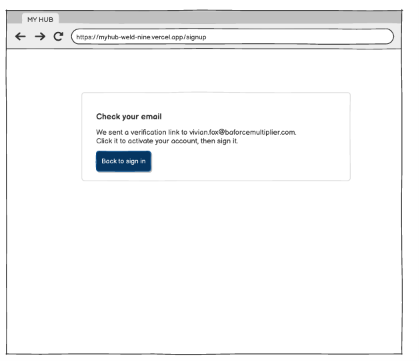
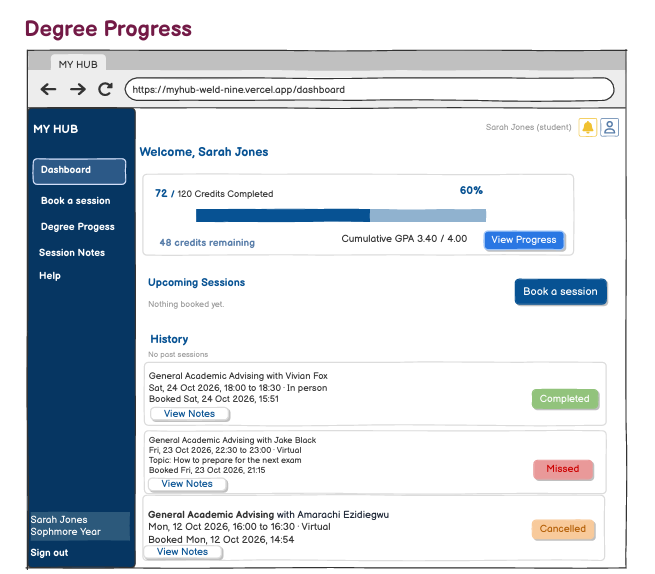
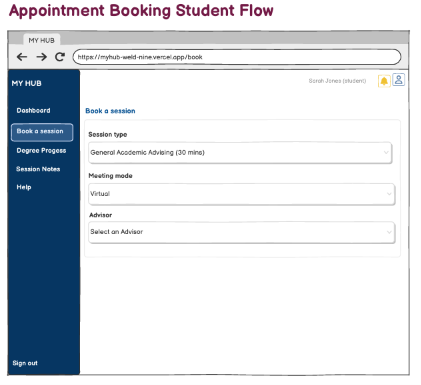
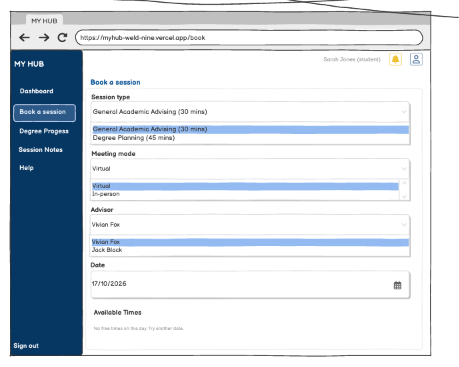
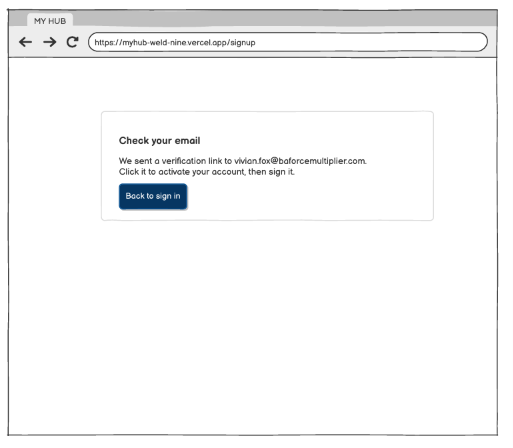
Screen Flows: Student, Admin and Advisor
Quality Assurance: Deborah Edu










Project Deliverables - By the Developer
Developer: Amarachi Ezidiegwu
Feasability Assessment
Value to Team:
The feasibility study provided an informed basis for project planning and decision-making. It helped the team understand the project requirements, assess available and required resources, identify potential constraints, and evaluate suitable implementation approaches to ensure alignment with business objectives.
Lessons Learned:
This was my first experience conducting a feasibility assessment, and it exposed me to the intricate considerations that go into determining whether and how a product should be built. I learned that a feasibility study is essential to understanding the scope of what lies ahead, evaluating available resources against project demands, identifying potential challenges, and determining the most suitable approach to delivering a solution that aligns with the business need.
Feasibility Assessment (Dev)
Initial Technical Feasibility Assessment
Case Study:
The university needs a new advising portal because the current advising process is confusing, slow, and inconsistent. Students struggle to schedule appointments, advisors cannot easily share or retrieve notes, and degree progress is difficult for students to understand. Leadership wants a simple, beginner‑friendly system that helps students schedule advising appointments, helps advisors record notes, and gives students a clear view of their degree progress.
The team is expected to design the Minimum Viable Product (MVP) of a brand‑new advising portal. (Build one system University Advising Portal)-web version that work for mobile version
Team: 3
Developer(s): Amarachi Lilian Ezidiegwu
Date: 13 September, 2026 since
1. Feasibility Conclusion
Overall assessment: Feasible with constraints / further investigation
Summary: Based on the information currently available, the proposed solution is achievable, but not as it was initially scoped. Constraints around development skill level, tooling familiarity, and unconfirmed infrastructure (server/domain, database) mean the team is more likely to deliver a functional prototype rather than a production-ready application, unless these gaps are resolved. There are no outright technical blockers identified yet, but several dependencies still need to be confirmed before a firm commitment can be made.
2. Proposed Solution at a High Level
The team is currently weighing two possible directions:
-
Functional prototype: a lower-fidelity build that demonstrates core functionality without requiring full backend infrastructure (server, domain, database) or dummy data.
-
Full application: a more complete, deployable solution, which would depend on securing hosting/domain availability and a working database, may be more achievable if AI-assisted development tools (e.g., Claude) are used to offset current coding skill gaps.
No detailed architecture has been defined yet; the direction will depend on decisions made around resourcing and tooling below.
3. Technology Feasibility
(document continues....)
Developer: Amarachi Ezidiegwu
MY Hub
University Advising Portal
video
Developer: Amarachi Ezidiegwu
MY Hub
University Advising Portal
https://myhub-weld-nine.vercel.app/degreeprogress
To Test:
Student flow -
Username- edudeborah@gmail.com
Password- Shesaid55
Advisor flow -
username - deborah.edu@baforcemultiplier.com
Password - Shesaid56
Impact of the SDLC Experience Workshop

Business Analyst
Jessie Lee (Hwee Ling Lee)
This workshop showed me how business needs become working solutions. When plans changed, I learned to agree on the basics before moving forward. Working across time zones and using a Kanban board taught me the value of teamwork. Retrospectives gave me a habit I’ll carry forward: turn every lesson into action and keep improving together.

Developer
Amarachi Ezidiegwu
Stepping into a new role and taking on responsibilities outside my usual area of expertise was a challenge I was willing to embrace, as my mentor has always encouraged me to be open to new experiences and opportunities for growth.
As an IT Business Analyst, this experience has given me a different perspective on software development and a better appreciation of the considerations, challenges, and decisions that developers encounter during the product development process. I believe this exposure will make me a more effective Business Analyst, particularly in how I communicate requirements, collaborate with developers, understand technical constraints, and contribute to solution design.
Coding was never initially part of my career plan. However, this experience has broadened my perspective and made me more open to exploring it. It has given me an opportunity to understand both sides of the product development process: translating business needs into solutions and understanding the technical work involved in bringing those solutions to life.
Ultimately, the programme has reinforced the importance of stepping outside familiar responsibilities, embracing new challenges, and developing a more holistic understanding of the technology and product development landscape.


